Minoxidil Alternatives for Hair Growth: What Actually Works?

Started minoxidil and now scared you'll be stuck with it forever? Or maybe you haven't started yet, because everyone online says your hair falls out first. You're not alone. The same question about minoxidil alternatives keeps popping up on Reddit.
And there's no shortage of serums promising the same results without the drama. So which ones actually work, and which ones are just good marketing? Let's find out!
TL;DR
-
Minoxidil works, but only while you use it. Stop, and you start shedding within 3 to 4 months.
-
A few alternatives have some proof. Rosemary oil, a caffeine lotion and a laser comb have the most promising studies. None is as well tested as minoxidil.
-
Redensyl, Capixyl and Procapil aren't proven yet. One small study of a lotion with one of the same ingredients looked promising. But that's not enough to call them a cure.
Why Are People Looking for a Minoxidil Alternative?
People usually want an alternative because minoxidil is a lifelong habit, it can make you shed at first, and some can't live with the side effects.

In the Pakistani Reddit threads we read, the same worries kept coming up:
-
"It's a lifetime medicine." Once you stop, people say the progress goes too.
-
The shedding phase. People worry they can't afford to lose more hair before the new hair comes in.
-
Side effects. Puffiness and unwanted facial hair.
And some people simply don't want to put a medicine on their head every day for the rest of their lives. Fair enough.
What Are the Side Effects of Minoxidil?
The most common minoxidil side effect is an itchy, flaky scalp. Unwanted facial hair and extra shedding are common too. And the biggest catch? You have to keep using it to keep the results.
A review of the minoxidil research says treatment has to carry on for good. If you stop, your hair starts shedding within 3 to 4 months. In one study of women, half the group using the 2% liquid grew extra hair on their face. A third of those on the 5% foam did too.
Extra shedding, itching, rashes and headaches also turn up on the list. The same review says minoxidil should be avoided during pregnancy and breastfeeding.
None of this means minoxidil is bad. It's still one of the main treatments doctors use. It just isn't for everyone.
First, Find Out Why Your Hair Is Falling
Before you swap minoxidil for anything, find out what's causing your hair fall. No serum can fix a missing vitamin.
Hair fall has lots of triggers: low iron or vitamin D, thyroid problems, PCOS, stress, or hair loss that runs in the family. On Pakistani forums, the most common advice is to get your iron, vitamin D and thyroid checked first. It's a simple blood test, and it tells you where to start.

Losing hair in round patches, or very fast? See a dermatologist. Our guide to the real causes of hair fall covers the rest.
Which Minoxidil Alternatives Actually Work?
Rosemary oil, a caffeine lotion and a laser comb have the most promising studies. Pumpkin seed oil and an anti-dandruff shampoo have weaker ones. But none of them have been tested anywhere near as much as minoxidil.
|
Option |
What the research found |
How strong is the proof? |
|---|---|---|
|
Rosemary oil |
About the same hair growth as 2% minoxidil after 6 months |
Some (one study, 100 people) |
|
Caffeine lotion |
Not much worse than 5% minoxidil at getting more hairs into the growing stage after 6 months |
Some (the men knew which one they were using) |
|
Laser comb |
More hair than a fake comb after 26 weeks |
Some (the maker paid some of the researchers) |
|
Pumpkin seed oil capsules |
More hair than a dummy pill after 24 weeks |
Weak (76 men, funded by the capsule maker) |
|
Pumpkin seed oil on the scalp |
Hair improved after 3 months, as it did with 5% minoxidil foam |
Weak (60 women, only 3 months, no dummy group) |
|
Anti-dandruff shampoo (ketoconazole) |
Similar results to minoxidil in one old study |
Weak (one old study; its authors asked for bigger ones) |
|
Peptide and plant lotion (acetyl tetrapeptide-3) |
About the same as 3% minoxidil after 24 weeks |
Weak (only 32 people) |

Rosemary oil is the one most of us already have at home. In one study of 100 people, rosemary oil and 2% minoxidil grew about the same amount of hair after 6 months. Nothing changed at 3 months, so give it time. Plus, the rosemary group had less scalp itching. Just remember that 2% is the milder strength, and many people use 5%.
Using rosemary essential oil? It's strong, so it always needs diluting. Our guide on rosemary oil vs rosemary essential oil explains the difference.
Pumpkin seed oil has been tested two ways. Men who swallowed it as capsules grew more hair than men on a dummy pill. And in a small study of 60 women, rubbing it into the scalp for 3 months improved their hair, as 5% minoxidil foam did. Both studies were small, though.
Ketoconazole is the anti-dandruff ingredient in many medicated shampoos. Got flakes and thinning? Our dandruff treatment guide will help.
Can a Derma Roller or PRP Replace Minoxidil?
No. Both were tested together with minoxidil, not instead of it.

In one 12-week study of 100 men, some had a weekly clinic session with a longer-needled roller on top of minoxidil. They grew far more hair than men on minoxidil alone. That's impressive. But we couldn't find a proper study of a derma roller on its own, and home rollers like ours use shorter needles. Think of it as the tadka, not the daal: it makes the dish better, but it isn't the dish.
PRP is a clinic treatment made from your own blood and injected into your scalp. The best review we found only looked at PRP used together with minoxidil, and it rated the proof as low to very low.
Is Redensyl Better Than Minoxidil?
Nobody knows yet. We couldn't find a single large, independent study comparing the two.

You'll see Redensyl, Capixyl, Procapil and Anagain on lots of hair growth serums sold in Pakistan. They're active ingredients made for the scalp. But the studies we found were small, or paid for by a company selling the product.
The best study we found tested a lotion with acetyl tetrapeptide-3, an active ingredient that's also in our spray, plus two plant extracts. After 24 weeks, it grew about as much hair as 3% minoxidil, and it caused less scalp irritation. But it only had 32 people.
Our honest take? These ingredients are worth trying, especially if minoxidil didn't suit you. Just don't believe anyone who calls them a guaranteed cure.
What About Finasteride?
Finasteride is a medicine, so it's a conversation for your doctor, not a pharmacy counter.
The NHS lists finasteride and minoxidil as the main treatments for male pattern baldness. It also says they only work for as long as you use them. Women shouldn't use finasteride at all.
How Do You Build a Hair Growth Routine Without Minoxidil?
Pick one scalp treatment and use it every single day. Add an oil massage a few times a week, and give it at least 6 months before you judge it.
Here's the routine we'd suggest:
-
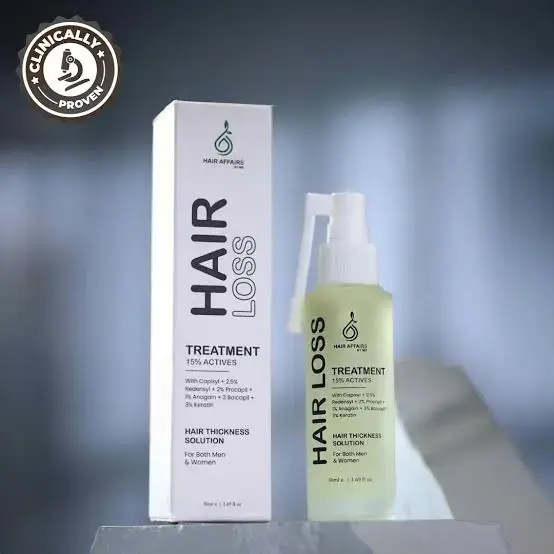
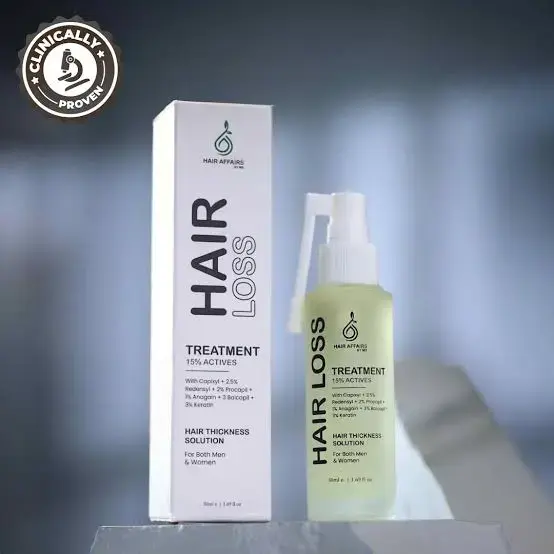
Every morning and night: spray 4 to 5 puffs of our Medicated Hair Loss Treatment onto a clean, dry scalp and massage it in with your fingertips. No need to wash it out. It's our hair growth serum without minoxidil, made with Redensyl, Capixyl, Procapil, Baicapil and Anagain, plus rosemary and onion extract.
-
Two or three times a week: massage our Anti Hair Fall and Hair Growth Oil into your scalp and hair. Leave it on for 2 to 6 hours, never overnight, then wash.
-
On wash day: add 2 to 3 drops of our Rosemary Essential Oil to your shampoo. Massage it only into your scalp for 2 to 3 minutes, then rinse well.
-
Optional: use a Derma Roller 2 to 3 times a week on a clean, dry scalp, then spray your treatment. Disinfect it in alcohol before and after every use.
-
Once a month: take a photo of your parting or hairline in the same spot and the same light. Mirrors lie; photos don't.

Pregnant or breastfeeding? Skip the spray and the rosemary essential oil, and speak to your doctor first. Under 18? Check with a doctor first; if they agree, use the spray only 1 to 2 times a week.
Frequently Asked Questions
What is the best alternative to minoxidil?
There's no single best alternative to minoxidil, because none has been tested as much. Rosemary oil is the easiest to try at home, and in one study it matched 2% minoxidil after 6 months. A caffeine lotion and a laser comb have some proof too. However, if your hair fall comes from low iron, vitamin D or a thyroid problem, fixing that matters more than any serum.
Is rosemary oil as good as minoxidil?
In one study of 100 people, rosemary oil grew about the same amount of hair as 2% minoxidil after 6 months, with less itching. That's promising, but it's just one study. And it was compared with the milder 2% strength, not 5%. However, rosemary essential oil must always be diluted, in shampoo or a carrier oil, before it touches your scalp.
Is Redensyl better than minoxidil?
There's no proof that Redensyl is better than minoxidil. We couldn't find a large, independent study comparing them, and the studies we did find were small or paid for by a seller. In one small study, a lotion with one of the same ingredients caused less scalp irritation than minoxidil. However, be wary of any brand that calls it a guaranteed cure, because no study backs that up.
What happens if I stop using minoxidil?
If you stop using minoxidil, you'll usually start shedding within 3 to 4 months. That's why it's a long-term treatment. However, if you want to stop, talk to a dermatologist first about what to use instead, so you're not starting from zero.
Can I use minoxidil during pregnancy?
No, minoxidil should be avoided during pregnancy and breastfeeding. We don't recommend our Medicated Hair Loss Treatment or Rosemary Essential Oil during pregnancy either. The safest move is to speak to your gynaecologist before using anything on your scalp.
The Bottom Line
Minoxidil alternatives do exist, but most have far less proof than the internet suggests. Rosemary oil is the easiest home option that's been tested directly against minoxidil. Redensyl and Capixyl are worth a try, but still unproven. And the biggest win is usually finding out why your hair is falling in the first place.
Ready to try a routine without minoxidil? Start with our Medicated Hair Loss Treatment and give it a fair 6 months; your future self will thank you for it!